Investor Charter-Stock Brokers
1. Vision
To follow highest standards of ethics and compliance while facilitating the trading by clients in securities in a fair and transparent manner, so as to contribute in creation of wealth for investors.
2. Mission
- To provide high quality and dependable service through innovation, capacity enhancement and use of technology.
- To establish and maintain a relationship of trust and ethics with the investors.
- To observe highest standard of compliance and transparency.
- To always keep "protection of investors' interest" as goal while providing service.
- To ensure confidentiality of information shared by investors unless such information is required to be provided in furtherance of discharging legal obligations or investors have provided specific consent to share such information.
3. Services Provided to Investors
- Execution of trades on behalf of investors.
- Issuance of Contract Notes.
- Issuance of intimations regarding margin due payments.
- Facilitate execution of early pay-in obligation instructions.
- Periodic Settlement of client's funds.
- Issuance of retention statement of funds at the time of settlement.
- Risk management systems to mitigate operational and market risk.
- Facilitate client profile changes in the system as instructed by the client.
- Information sharing with the client w.r.t. relevant Market Infrastructure Institutions (MII) circulars.
- Provide a copy of Rights& Obligations document to the client.
- Communicating Most Important terms and Conditions (MITC) to the client.
- Redressal of Investor's grievances.
4. Rights of Investors
- Ask for and receive information from a firm about the work history and background of the person handling your account, as well as information about the firm itself (including website providing mandatory information).
- Receive complete information about the risks, obligations, and costs of any investment before investing.
- Receive a copy of all completed account forms and rights & obligation document.
- Receive a copy of 'Most Important Terms & Conditions' (MITC).
- Receive account statements that are accurate and understandable.
- Understand the terms and conditions of transactions you undertake.
- Access your funds in a prescribed manner and receive information about any restrictions or limitations on access.
- Receive complete information about maintenance or service charges, transaction or redemption fees, and penalties in form of tariff sheet.
- Discuss your grievances with compliance officer / compliance team / dedicated grievance redressal team of the firm and receive prompt attention to and fair consideration of your concerns.
- Close your zero balance accounts online with minimal documentation
- Get the copies of all policies (including Most Important Terms and Conditions) of the broker related to dealings of your account
- Not be discriminated against in terms of services offered to equivalent clients.
- Get only those advertisement materials from the broker which adhere to Code of Advertisement norms in place.
- In case of broker defaults, be compensated from the Exchange Investor Protection Fund as per the norms in place.
- Trade in derivatives after submission of relevant financial documents to the broker subject to brokers' adequate due diligence.
- Get warnings on the trading systems while placing orders in securities where surveillance measures are in place.
- Get access to products and services in a suitable manner even if differently abled.
- Get access to educational materials of the MIIs and brokers.
- Get access to all the exchanges of a particular segment you wish to deal with unless opted out specifically as per Broker norms.
- Deal with one or more stockbrokers of your choice without any compulsion of minimum business.
- Have access to the escalation matrix for communication with the broker.
- Not be bound by any clause prescribed by the Brokers which are contravening the Regulatory provisions.
5. Various activities of Stock Brokers with timelines
| S.No. | Activities | Expected Timelines |
|---|---|---|
| 1. | KYC entered into KRA System and CKYCR | 10 days of account opening |
| 2. | Client Onboarding | Immediate, but not later than one week |
| 3. | Order execution | Immediate on receipt of order, but not later than the same day |
| 4. | Allocation of Unique Client Code | Before trading |
| 5. | Copy of duly completed Client Registration Documents to clients | 7 days from the date of upload of Unique Client Code to the Exchange by the trading member |
| 6. | Issuance of contract notes | 24 hours of execution of trades |
| 7. | Collection of upfront margin from client | Before initiation of trade |
| 8. | Issuance of intimations regarding other margin due payments | At the end of the T day |
| 9. | Settlement of client funds | 30 days / 90 days for running account settlement (RAS) as per the preference of client. If consent not given for RAS – within 24 hours of pay-out |
| 10. | ‘Statement of Accounts’ for Funds, Securities and Commodities | Weekly basis (Within four trading days of following week) |
| 11. | Issuance of retention statement of funds/commodities | 5 days from the date of settlement |
| 12. | Issuance of Annual Global Statement | 30 days from the end of the financial year |
| 13. | Investor grievances redressal | 30 days from the receipt of the complaint |
6. DOs and DON'Ts for Investors
| DOs | DON'Ts |
|---|---|
| 1. Read all documents and conditions being agreed before signing the account opening form. | 1. Do not deal with unregistered stock broker. |
| 2. Receive a copy of KYC, copy of account opening documents and Unique Client Code. | 2. Do not forget to strike off blanks in your account opening and KYC. |
| 3. Read the product / operational framework / timelines related to various Trading and Clearing & Settlement processes. | 3. Do not submit an incomplete account opening and KYC form. |
| 4. Receive all information about brokerage, fees and other charges levied. | 4. Do not forget to inform any change in information linked to trading account and obtain confirmation of updation in the system. |
| 5. Register your mobile number and email ID in your trading, demat and bank accounts to get regular alerts on your transactions. | 5. Do not transfer funds, for the purposes of trading to anyone other than a stock broker. No payment should be made in name of employee of stock broker. |
| 6. If executed, receive a copy of Power of Attorney. However, Power of Attorney is not a mandatory requirement as per SEBI / Stock Exchanges. Before granting Power of Attorney, carefully examine the scope and implications of powers being granted. | 6. Do not ignore any emails / SMSs received with regards to trades done, from the Stock Exchange and raise a concern, if discrepancy is observed. |
| 7. Receive contract notes for trades executed, showing transaction price, brokerage, GST and STT etc. as applicable, separately, within 24 hours of execution of trades. | 7. Do not opt for digital contracts, if not familiar with computers. |
| 8. Receive funds and securities / commodities on time within 24 hours from pay-out. | 8. Do not share trading password. |
| 9. Verify details of trades, contract notes and statement of account and approach relevant authority for any discrepancies. Verify trade details on the Exchange websites from the trade verification facility provided by the Exchanges. | 9. Do not fall prey to fixed / guaranteed returns schemes. |
| 10. Receive statement of accounts periodically. If opted for running account settlement, account has to be settled by the stock broker as per the option given by the client (30 or 90 days). | 10. Do not fall prey to fraudsters sending emails and SMSs luring to trade in stocks / securities promising huge profits. |
| 11. In case of any grievances, approach stock broker or Stock Exchange or SEBI for getting the same resolved within prescribed timelines. | 11. Do not follow herd mentality for investments. Seek expert and professional advice for your investments. |
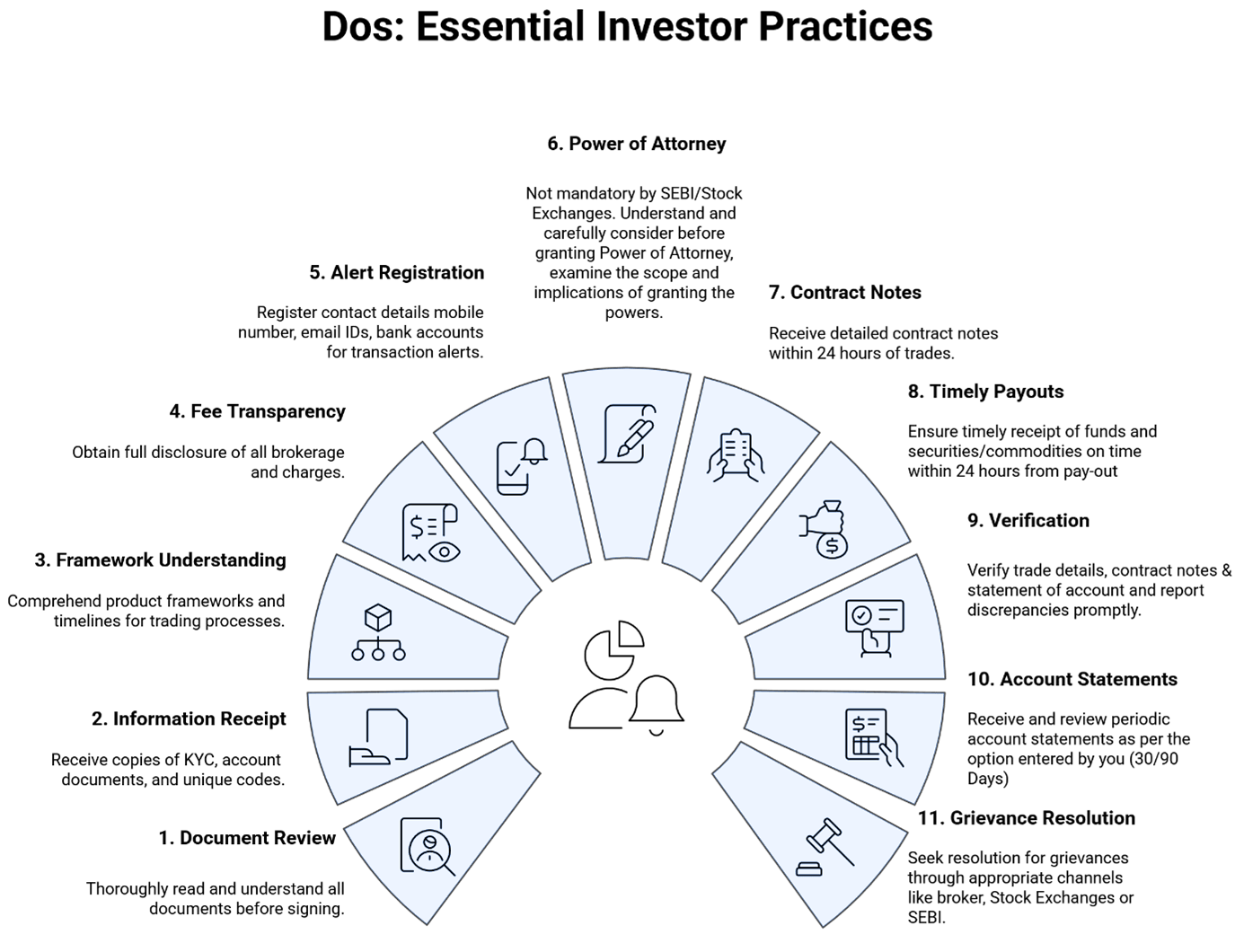
Dos: Essential Investor Practices, an 11-step circular diagram. 1. Document Review: thoroughly read and understand all documents before signing. 2. Information Receipt: receive copies of KYC, account documents, and unique codes. 3. Framework Understanding: comprehend product frameworks and timelines for trading processes. 4. Fee Transparency: obtain full disclosure of all brokerage and charges. 5. Alert Registration: register contact details, mobile number, email IDs, bank accounts for transaction alerts. 6. Power of Attorney: not mandatory by SEBI/Stock Exchanges, understand and carefully consider before granting Power of Attorney, examine the scope and implications of granting the powers. 7. Contract Notes: receive detailed contract notes within 24 hours of trades. 8. Timely Payouts: ensure timely receipt of funds and securities/commodities within 24 hours from pay-out. 9. Verification: verify trade details, contract notes and statement of account, and report discrepancies promptly. 10. Account Statements: receive and review periodic account statements as per the option entered by you, 30 or 90 days. 11. Grievance Resolution: seek resolution for grievances through appropriate channels like broker, Stock Exchanges or SEBI.
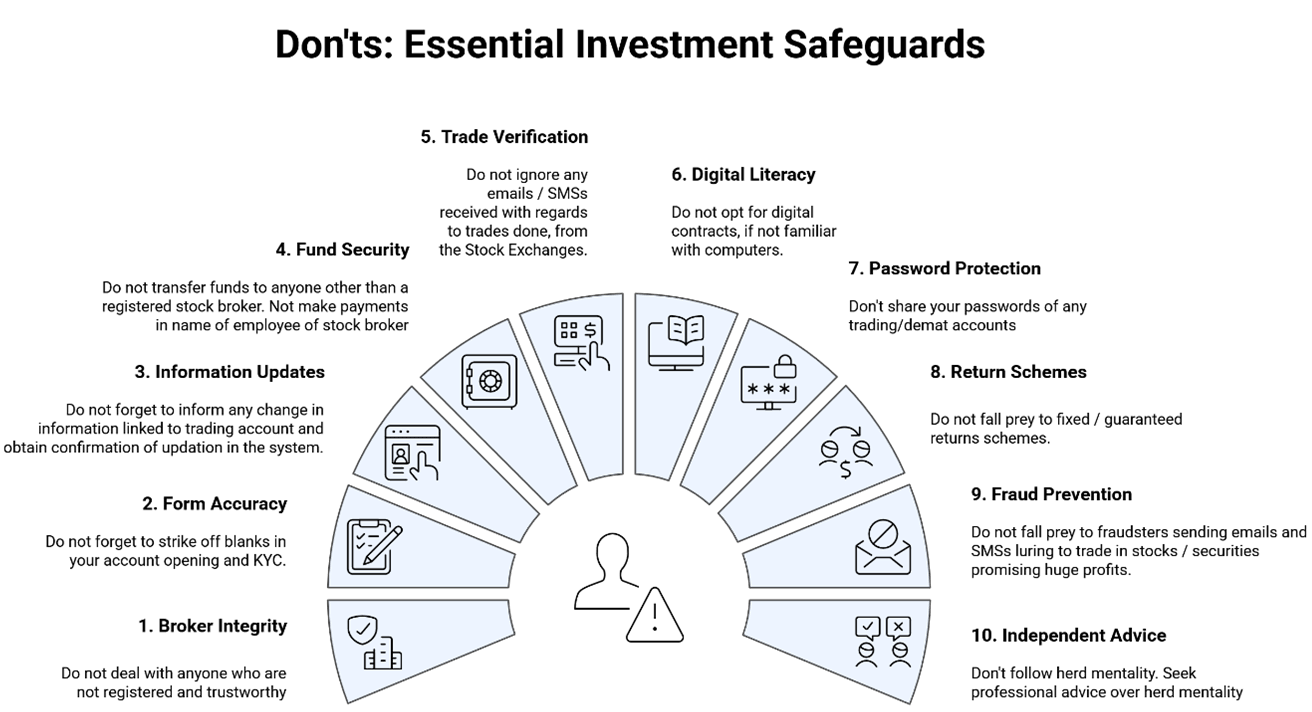
Don'ts: Essential Investment Safeguards, a 10-step circular diagram. 1. Broker Integrity: do not deal with anyone who is not registered and trustworthy. 2. Form Accuracy: do not forget to strike off blanks in your account opening and KYC forms. 3. Information Updates: do not forget to inform any change in information linked to your trading account and obtain confirmation of updation in the system. 4. Fund Security: do not transfer funds to anyone other than a registered stock broker, do not make payments in the name of an employee of a stock broker. 5. Trade Verification: do not ignore any emails or SMS received regarding trades done, from the Stock Exchanges. 6. Digital Literacy: do not opt for digital contracts if not familiar with computers. 7. Password Protection: don't share your passwords of any trading or demat accounts. 8. Return Schemes: do not fall prey to fixed or guaranteed return schemes. 9. Fraud Prevention: do not fall prey to fraudsters sending emails and SMS luring you to trade in stocks or securities promising huge profits. 10. Independent Advice: don't follow herd mentality, seek professional advice over herd mentality.
7. Grievance Redressal Mechanism
| Sr. No. | The Process of investor grievance redressal | Details |
|---|---|---|
| 1. | Investor Complaint/Grievances | Investor can lodge complaint/grievance against stock broker in the following ways: Mode of filing the complaint with stock broker Investor can approach the Stock Broker at the designated Investor Grievance e-mail ID of the stock broker. The Stock Broker will strive to redress the grievance immediately, but not later than 21 days of the receipt of the grievance Mode of filing the complaint with stock exchanges i. SCORES 2.0 (a web based centralized grievance redressal system of SEBI) (https://scores.sebi.gov.in) ii. Two level review for complaint/grievance against stock broker: a. First review done by Designated body/Exchange b. Second review done by SEBI iii. Emails to designated email IDs of Exchange |
| 2. | Online Dispute Resolution (ODR) platform for online Conciliation and Arbitration | If the Investor is not satisfied with the resolution provided by the Market Participants, then the Investor has the option to file the complaint/grievance on SMARTODR platform for its resolution through by online conciliation or arbitration. https://smartodr.in/register |
| 3. | Steps to be followed in ODR for Review, Conciliation and Arbitration |
|
For the multi-level complaint resolution mechanism available at the Depositories https://bullsmart.in/investor-grievance-escalation-matrix
Level 1 - Approach the Stock Broker at the designated Investor Grievance e-mail ID of the stock broker. The Stock Broker will strive to redress the grievance immediately, but not later than 30 days of the receipt of the grievance.
Level 2 - Approach the Stock Exchange using the grievance mechanism mentioned at the website of the respective exchange.
Complaints Resolution Process at Stock Exchange explained graphically:(Note: Graphical representation not reproducible in text; refer to original PDF for flowchart depicting complaint lodging, sharing with broker, amicable resolution, GRC, Arbitration, Appellate Arbitration, and Court suit.)
Level 3 - The complaint not redressed at Stock Broker / Stock Exchange level, may be lodged with SEBI on SCORES (a web based centralized grievance redressal system of SEBI) @
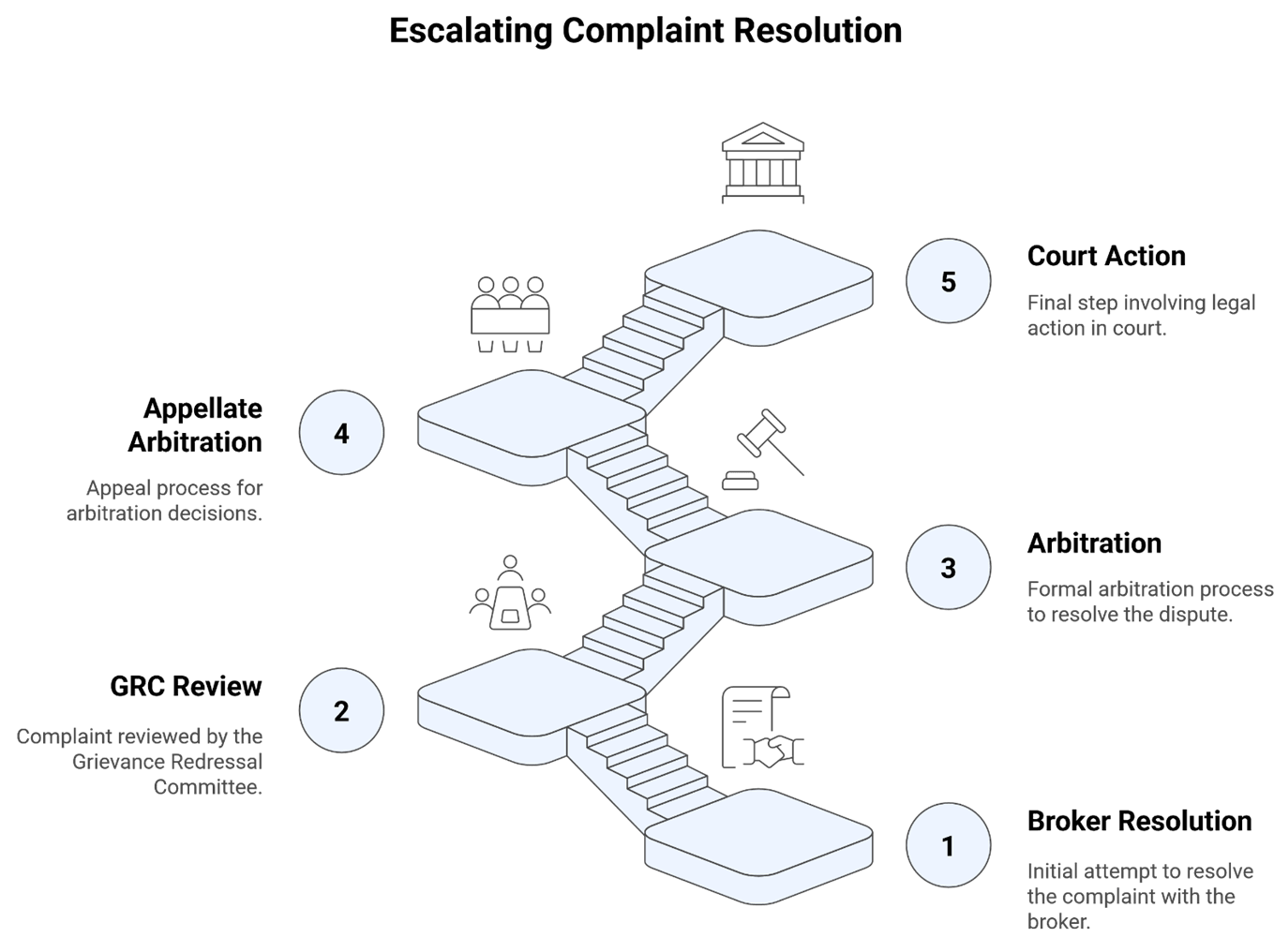
Escalating Complaint Resolution, a 5-step process. 1. Broker Resolution: initial attempt to resolve the complaint with the broker. 2. GRC Review: complaint reviewed by the Grievance Redressal Committee. 3. Arbitration: formal arbitration process to resolve the dispute. 4. Appellate Arbitration: appeal process for arbitration decisions. 5. Court Action: final step involving legal action in court.
Timelines for complaint resolution process at Stock Exchanges against stock brokers
| Sl. No. | Type of Activity | Timelines for activity |
|---|---|---|
| 1. | Receipt of Complaint | Day of complaint (C Day). |
| 2. | Additional information sought from the investor, if any, and provisionally forwarded to stock broker. | C + 7 Working days. |
| 3. | Registration of the complaint and forwarding to the stock broker. | C+8 Working Days i.e. T day. |
| 4. | Amicable Resolution. | T+15 Working Days. |
| 5. | Refer to Grievance Redressal Committee (GRC), in case of no amicable resolution. | T+16 Working Days. |
| 6. | Complete resolution process post GRC. | T + 30 Working Days. |
| 7. | In case where the GRC Member requires additional information, GRC order shall be completed within. | T + 45 Working Days. |
| 8. | Implementation of GRC Order. | On receipt of GRC Order, if the order is in favour of the investor, debit the funds of the stock broker. Order for debit is issued immediately or as per the directions given in GRC order. |
| 9. | In case the stock broker is aggrieved by the GRC order, will provide intention to avail arbitration | Within 7 days from receipt of order |
| 10. | If intention from stock broker is received and the GRC order amount is upto Rs.20 lakhs | Investor is eligible for interim relief from Investor Protection Fund (IPF). The interim relief will be 50% of the GRC order amount or Rs.2 lakhs whichever is less. The same shall be provided after obtaining an Undertaking from the investor. |
| 11. | Stock Broker shall file for arbitration | Within 6 months from the date of GRC recommendation |
| 12. | In case the stock broker does not file for arbitration within 6 months | The GRC order amount shall be released to the investor after adjusting the amount released as interim relief, if any. |
8. Handling ofInvestor's claims / complaints in case of default of a Trading Member / Clearing Member (TM/CM)
Default of TM/CM Following steps are carried out by Stock Exchange for benefit of investor, in case stock broker defaults:
- Circular is issued to inform about declaration of Stock Broker as Defaulter.
- Information of defaulter stock broker is disseminated on Stock Exchange website.
- Public Notice is issued informing declaration of a stock broker as defaulter and inviting claims within specified period.
- Intimation to clients of defaulter stock brokers via emails and SMS for facilitating lodging of claims within the specified period
Following information is available on Stock Exchange website for information of investors:
- Norms for eligibility of claims for compensation from IPF.
- Claim form for lodging claim against defaulter stock broker.
- FAQ on processing of investors' claims against Defaulter stock broker.
- Provision to check online status of client's claim.
- Standard Operating Procedure (SOP) for handling of Claims of Investors in the Cases of Default by Brokers.
- Claim processing policy against Defaulter/Expelled members.
- List of Defaulter/Expelled members and public notice issue.
Investor Charter - Depository Participant
1. Vision
Towards making Indian Securities Market - Transparent, Efficient, & Investor friendly by providing safe, reliable, transparent and trusted record keeping platform for investors to hold and transfer securities in dematerialized form.
2. Mission
- To hold securities of investors in dematerialised form and facilitate its transfer, while ensuring safekeeping of securities and protecting interest of investors.
- To provide timely and accurate information to investors with regard to their holding and transfer of securities held by them.
- To provide the highest standards of investor education, investor awareness and timely services so as to enhance Investor Protection and create awareness about Investor Rights.

Vision - Enhancing Indian Securities Market, illustrated as an umbrella with six supporting pillars: Transparency, ensuring clear and open market operations. Efficiency, streamlining processes for quick transactions. Investor Friendliness, creating a welcoming environment for investors. Safety, protecting investments from risks. Reliability, providing consistent and dependable services. Trust, building confidence in market integrity.
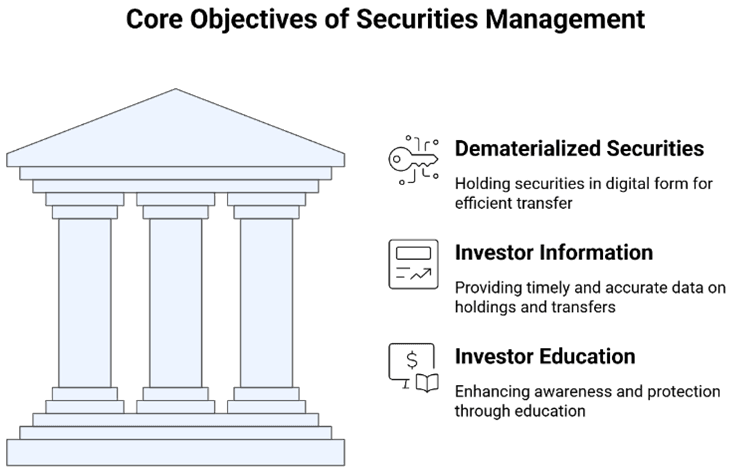
Core Objectives of Securities Management: Dematerialized Securities, holding securities in digital form for efficient transfer. Investor Information, providing timely and accurate data on holdings and transfers. Investor Education, enhancing awareness and protection through education.
3. Details of business transacted by the Depository and Depository Participant (DP)
A Depository is an organization which holds securities of investors in electronic form. Depositories provide services to various market participants - Exchanges, Clearing Corporations, Depository Participants (DPs), Issuers and Investors in both primary as well as secondary markets. The depository carries out its activities through its agents which are known as Depository Participants (DP). Details available on https://www.cdslindia.com/eservices/DP/DPList(opens in new tab)
4. Description of services provided by the Depository through Depository Participants (DP) to investors
(4.1) Basic Services
| Sr. No. | Brief about the Activity / Service | Expected Timelines for processing by the DP after receipt of proper documents |
|---|---|---|
| 1. | Dematerialization of securities | 7 days |
| 2. | Rematerialization of securities | 7 days |
| 3. | Mutual Fund Conversion / Destatementization | 5 days |
| 4. | Re-conversion / Restatementisation of Mutual fund units | 7 days |
| 5. | Transmission of securities | 7 days |
| 6. | Registering pledge request | 15 days |
| 7. | Closure of demat account | 30 days |
| 8. | Settlement Instruction | For T+1 day settlements, Participants shall accept instructions from the Clients, in physical form up to 4 p.m. (in case of electronic instructions up to 6.00 p.m.) on T day for pay-in of securities. For T+0 day settlements, Participants shall accept EPI instructions from the clients, till 11:00 AM on T day. Note: 'T' refers 'Trade Day' |
(4.2) Depositories provide special services like pledge, hypothecation, internet-based services etc. in addition to their core services and these include
| Sr. No. | Type of Activity / Service | Brief about the Activity / Service |
|---|---|---|
| 1. | Value Added Services | Depositories also provide value added services such as
|
| 2. | Consolidated Account statement (CAS) | CAS is issued 10 days from the end of the month (if there were transactions in the previous month) or half yearly (if no transactions). |
| 3. | Digitalization services provided by the depositories | Depositories offer below technology solutions and e-facilities to their demat account holders through DPs: |
5. Details of Grievance Redressal Mechanism
| Sr. No. | 5.1. The Process of investor grievance redressal | Details |
|---|---|---|
| 1. | Investor Complaint/Grievances | Investor can lodge complaint/ grievance against the Depository/DP in the following ways: a. Electronic mode – (i) SCORES 2.0 (a web based centralized grievance redressal system of SEBI) Website Link(opens in new tab) Two Level Review for complaint/grievance against DP: - First review done by Designated Body- Second review done by SEBI (ii) Respective Depository’s web portal dedicated for the filing of complaint https://www.cdslindia.com/Footer/grievances.aspx(opens in new tab) (iii) Emails to designated email IDs of Depository complaints@cdslindia.com b. Offline mode - For tracking of your grievance, we request you to submit the same online through the portal. The complaints/ grievances lodged directly with the Depository shall be resolved within 21 days. |
| 2. | Online Dispute Resolution (ODR) platform for online Conciliation and Arbitration | If the Investor is not satisfied with the resolution provided by DP or other Market Participants, then the Investor has the option to file the complaint/grievance on SMARTODR platform for its resolution through by online conciliation or arbitration. https://smartodr.in/register(opens in new tab) |
| 3. | Steps to be followed in ODR for Review, Conciliation and Arbitration |
|
5.2. For the multi-level complaint resolution mechanism available at the Depositories https://bullsmart.in/investor-grievance-escalation-matrix
6. Guidance pertaining to special circumstances related to market activities: Termination of the Depository Participant
| Sr. No. | Type of special circumstances | Timelines for the Activity/ Service |
|---|---|---|
| 1. | Depositories to terminate the participation in case a participant no longer meets the eligibility criteria and/or any other grounds as mentioned in the bye laws like suspension of trading member by the Stock Exchanges. | Client will have a right to transfer all its securities to any other Participant of its choice without any charges for the transfer within 30 days from the date of intimation by way of letter/email. |
| 2. | Participant surrenders the participation by its own wish. | — |
7. Dos and Don'ts for Investors
8. Rights of Investors
9. Responsibilities of Investors
10. Code of Conduct for Depositories (Part D of Third Schedule of SEBI (D & P) regulations, 2018)
11. Code of Conduct for Participants (Part A of Third Schedule of SEBI (D & P) regulations, 2018)
Information contained in links to the investor charter
This section of the document contains the contents in main Charter mapped with the same superscript.
Para 4 (2) of Investor Charter
Point 1: Value Added Services
The facility of BSDA with limited services for eligible individuals was introduced with the objective of achieving wider financial inclusion and to encourage holding of demat accounts. No Annual Maintenance Charges (AMC) shall be levied, if the value of securities holding is up to Rs. 50,000. For value of holdings between Rs 50,001- 2,00,000, AMC not exceeding Rs 100 is chargeable. In case of debt securities, there are no AMC charges for holding value up to Rs 1,00,000 and a maximum of Rs 100 as AMC is chargeable for value of holdings between Rs 1,00,001 and Rs 2,00,000.
Transposition cum dematerializationIn case of transposition-cum- dematerialisation, client can get securities dematerialised in the same account if the names appearing on the certificates match with the names in which the account has been opened but are in a different order. The same may be done by submitting the security certificates along with the Transposition Form and Demat Request Form.
Linkages with Clearing SystemFor actual delivery of securities to the clearing system from the selling brokers and delivery of securities from the clearing system to the buying broker.
Point 3: Digitization of services provided by the depositories
Account opening through digital mode, popularly known as "On-line Account opening" where in investor intending to open demat account can visit DP website, fill in the required information, submit the required documents, conduct video IPV and demat account gets opened without visiting DP's office.
Online instructions for executionInternet-enabled services like Speed-e (NSDL) & Easiest (CDSL) empower a demat account holder in managing his/her securities me- in an efficient and convenient manner and submit instructions online without the need to use paper. These facilities allow Beneficial Owner (BO) to submit transfer instructions and pledge instructions through margin pledge from the demat account. The instruction facilities are also available on mobile applications through android, windows and IOS platforms.
e-DIS / Demat GatewayInvestors can give instructions for transfer of securities through e-DIS apart from physical DIS. Here, for on- market transfer of securities, investors need to provide settlement number along with the ISIN and quantity of securities being authorized for transfer. Client shall be required to authorize each e-DIS valid for a single settlement number/ settlement date, by way of OTP and PIN/ password, both generated at Depositories end. Necessary risk containment measures are being adapted by Depositories in this regard.
e-CAS facilityConsolidated Account Statements are available online and could also be accessed through mobile app to facilitate the investors to view their holdings in demat form.
Miscellaneous servicesTransaction alerts through SMS, e-locker facilities, chatbots for instantaneously responding to investor queries etc have also been developed.
Para 5 (1) of Investor Charter
Point 2(Investor Grievance Redressal Committee of Depository)
If no amicable resolution is arrived, then the Investor has the option to refer the compliant/ grievance to the Grievance Redressal Committee (GRC) of the Depository. Upon receipt of reference, the GRC will endeavour to resolve the complaint/ grievance by hearing the parties and examining the necessary information and documents.
Point 3(Arbitration proceedings)
The Investor may also avail the arbitration mechanism set out in Byelaws and Business Rules/ Operating Instructions of the Depository in relation to any grievance, or dispute relating to depository services. The arbitration reference shall be concluded by way of issue of an arbitral award within 4 months from the date of appointment of arbitrator(s).
Para 5 (2) of Investor Charter
Complaint Resolution process at Depositories
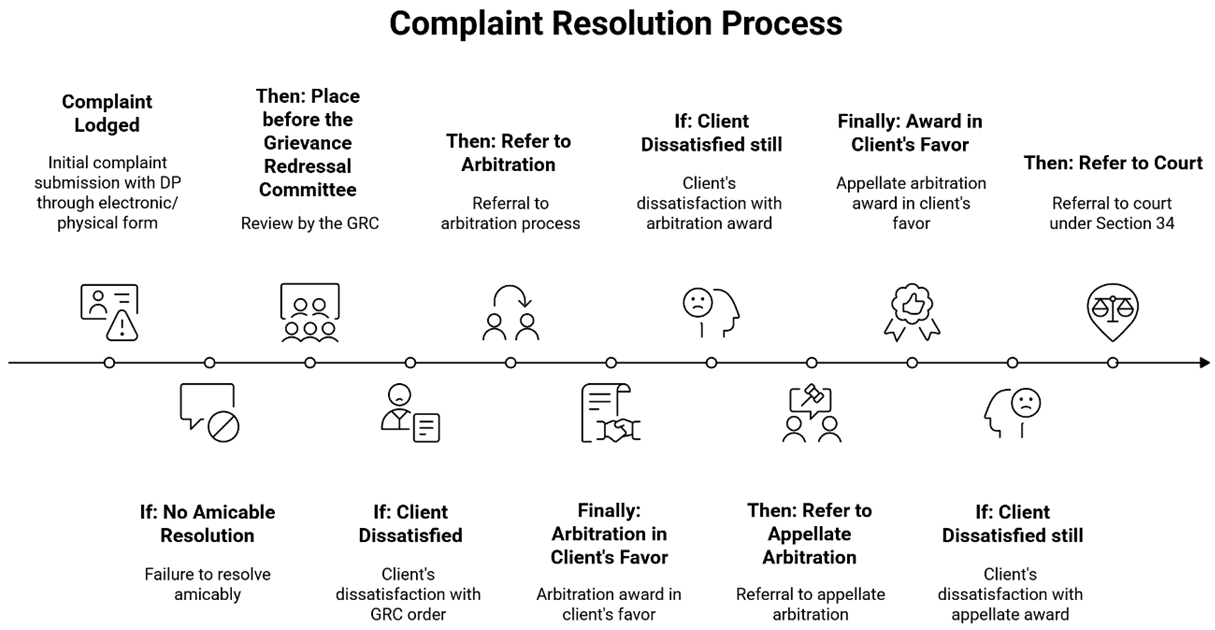
Complaint Resolution Process, shown as a timeline. Complaint Lodged: initial complaint submission with the DP through electronic or physical form. If no amicable resolution: failure to resolve amicably. Then, place before the Grievance Redressal Committee: review by the GRC. If client dissatisfied: client's dissatisfaction with the GRC order. Then, refer to arbitration: referral to the arbitration process. Finally, arbitration in client's favor: arbitration award in the client's favor. If client dissatisfied still: client's dissatisfaction with the arbitration award. Then, refer to appellate arbitration: referral to appellate arbitration. Finally, award in client's favor: appellate arbitration award in the client's favor. If client dissatisfied still: client's dissatisfaction with the appellate award. Then, refer to court: referral to court under Section 34.
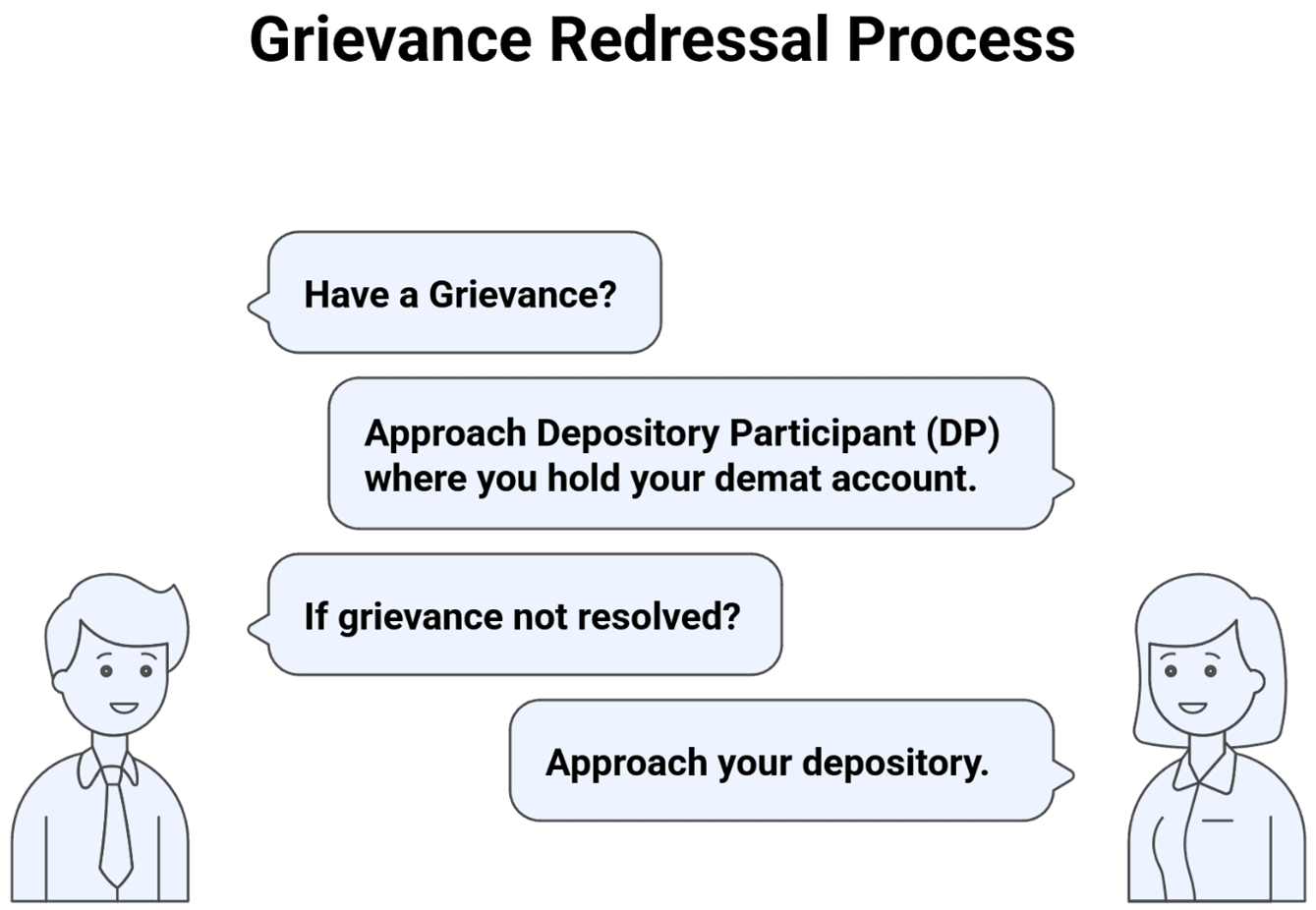
Grievance Redressal Process, shown as a conversation. Have a grievance? Approach the Depository Participant (DP) where you hold your demat account. If grievance not resolved? Approach your depository.
Depository Contact Information. NSDL Helpline: NSDL toll-free numbers for assistance, 1800-10-20990 or 1800-22-4430. NSDL Email: email address for NSDL grievance resolution, relations@nsdl.co.in. CDSL Helpline: CDSL toll-free number for customer support, 1800-22-5533. CDSL Email: email address for CDSL complaint submission, complaints@cdslindia.com.
Para 7 of Investor Charter
Dos and for Investor
| Sl No. | Guidance |
|---|---|
| 1 | Always deal with a SEBI registered Depository Participant for opening a demat account. |
| 2 | Read all the documents carefully before signing them. |
| 3 | Before granting Power of attorney to operate your demat account to an intermediary like Stock Broker, Portfolio Management Services (PMS) etc., carefully examine the scope and implications of powers being granted. |
| 4 | Always make payments to registered intermediary using banking channels. No payment should be made in name of employee of intermediary. |
| 5 |
|
| 6 | Inform any change in your Personal Information (for example address or Bank Account details, email ID, Mobile number) linked to your demat account in the prescribed format and obtain confirmation of updation in system |
| 7 | Mention your Mobile Number and email ID in account opening form to receive SMS alerts and regular updates directly from depository. |
| 8 | Always ensure that the mobile number and email ID linked to your demat account are the same as provided at the time of account opening/updation. |
| 9 | Do not share password of your online trading and demat account with anyone. |
| 10 | Do not share One Time Password (OTP) received from banks, brokers, etc. These are meant to be used by you only. |
| 11 | Do not share login credentials of e-facilities provided by the depositories such as e-DIS/demat gateway, SPEED-e/easiest etc. with anyone else. |
| 12 | Demat is mandatory for any transfer of securities of Listed public limited companies with few exceptions. |
| 13 | If you have any grievance in respect of your demat account, please write to designated email IDs of depositories or you may lodge the same with SEBI online at https://scores.sebi.gov.in/scores/Welcome.html(opens in new tab) |
| 14 | Keep a record of documents signed, DIS issued and account statements received. |
| 15 | As Investors you are required to verify the transaction statement carefully for all debits and credits in your account. In case of any unauthorized debit or credit, inform the DP or your respective Depository. |
| 16 | Appoint a nominee to facilitate your heirs in obtaining the securities in your demat account, on completion of the necessary procedures. |
| 17 | Register for Depository's internet based facility or download mobile app of the depository to monitor your holdings. |
| 18 | Ensure that, both, your holding and transaction statements are received periodically as instructed to your DP. You are entitled to receive a transaction statement every month if you have any transactions. |
| 19 | Do not follow herd mentality for investments. Seek expert and professional advice for your investments |
| 20 | Beware of assured/fixed returns. |
Para 8 of Investor Charter
Rights of investors
- Receive a copy of KYC, copy of account opening documents.
- No minimum balance is required to be maintained in a demat account.
- No charges are payable for opening of demat accounts.
- If executed, receive a copy of Power of Attorney. However, Power of Attorney is not a mandatory requirement as per SEBI/Stock Exchanges. You have the right to revoke any authorization given at any time.
- You can open more than one demat account in the same name with single DP/ multiple DPs.
- Receive statement of accounts periodically. In case of any discrepancies in statements, take up the same with the DP immediately. If the DP does not respond, take up the matter with the Depositories.
- Pledge and /or any other interest or encumbrance can be created on demat holdings.
- Right to give standing instructions with regard to the crediting of securities in demat account.
- Investor can exercise its right to freeze/defreeze his/her demat account or specific securities / specific quantity of securities in the account, maintained with the DP.
- In case of any grievances, Investor has right to approach Participant or Depository or SEBI for getting the same resolved within prescribed timelines.
- Every eligible investor shareholder has a right to cast its vote on various resolutions proposed by the companies for which Depositories have developed an internet based - platform.
- Receive information about charges and fees. Any charges/tariff agreed upon shall not increase unless a notice in writing of not less than thirty days is given to the Investor.
- Right to indemnification for any loss caused due to the negligence of the Depository or the participant.
- Right to opt out of the Depository system in respect of any security.
Para 9 of Investor Charter
Responsibilities of Investors
- Deal with a SEBI registered DP for opening demat account, KYC and Depository activities.
- Provide complete documents for account opening and KYC (Know Your Client). Fill all the required details in Account Opening Form / KYC form in own handwriting and cancel out the blanks.
- Read all documents and conditions being agreed before signing the account opening form.
- Accept the Delivery Instruction Slip (DIS) book from DP only (preprinted with a serial number along with client ID) and keep it in safe custody and do not sign or issue blank or partially filled DIS.
- Always mention the details like ISIN, number of securities accurately.
- Inform any change in information linked to demat account and obtain confirmation of updation in the system.
- Regularly verify balances and demat statement and reconcile with trades / transactions.
- Appoint nominee(s) to facilitate heirs in obtaining the securities in their demat account.
- Do not fall prey to fraudsters sending emails and SMSs luring to trade in stocks / securities promising huge profits.
Para 10 of Investor Charter
Code of Conduct for Depositories
A Depository shall:
| Sr. No. | Code of Conduct for Depositories (Part D of Third Schedule of SEBI (D & P) Regulations, 2018) |
|---|---|
| (a) | Always abide by the provisions of the Act, Depositories Act, 1996, any Rules or Regulations framed thereunder, circulars, guidelines and any other directions issued by the Board from time to time. |
| (b) | Adopt appropriate due diligence measures. |
| (c) | Take effective measures to ensure implementation of proper risk management framework and good governance practices. |
| (d) | Take appropriate measures towards investor protection and education of investors. |
| (e) | Treat all its applicants/members in a fair and transparent manner. |
| (f) | Promptly inform the Board of violations of the provisions of the Act, the Depositories Act, 1996, rules, regulations, circulars, guidelines or any other directions by any of its issuer or issuer’s agent. |
| (g) | Take a proactive and responsible attitude towards safeguarding the interests of investors, integrity of depository’s systems and the securities market. |
| (h) | Endeavour for introduction of best business practices amongst itself and its members. |
| (i) | Act in utmost good faith and shall avoid conflict of interest in the conduct of its functions. |
| (j) | Not indulge in unfair competition, which is likely to harm the interests of any other Depository, their participants or investors or is likely to place them in a disadvantageous position while competing for or executing any assignment. |
| (k) | Segregate roles and responsibilities of key management personnel within the depository including: a. Clearly mapping legal and regulatory duties to the concerned position b. Defining delegation of powers to each position c. Assigning regulatory, risk management and compliance aspects to business and support teams |
| (l) | Be responsible for the acts or omissions of its employees in respect of the conduct of its business. |
| (m) | Monitor the compliance of the rules and regulations by the participants and shall further ensure that their conduct is in a manner that will safeguard the interest of investors and the securities market. |
Para 11 of Investor Charter
Code of Conduct for Participants
| Sr. No. | Code of Conduct for Participants (Part A of Third Schedule of SEBI (D & P) Regulations, 2018) |
|---|---|
| 1. | A participant shall make all efforts to protect the interests of investors. |
| 2(a). | Render the best possible advice to the clients having regard to the client’s needs and the environments and his own professional skills; |
| 2(b). | Ensure that all professional dealings are effected in a prompt, effective and efficient manner; |
| 2(c). | Inquiries from investors are adequately dealt with; |
| 2(d). | Grievances of investors are redressed without any delay. |
| 3. | A participant shall maintain high standards of integrity in all its dealings with its clients and other intermediaries, in the conduct of its business. |
| 4. | A participant shall be prompt and diligent in opening of a beneficial owner account, dispatch of the dematerialisation request form, re-materialisation request form and execution of debit instruction slip and in all the other activities undertaken by him on behalf of the beneficial owners. |
| 5. | A participant shall endeavour to resolve all the complaints against it or in respect of the activities carried out by it as quickly as possible, and not later than one month of receipt. |
| 6. | A participant shall not increase charges/fees for the services rendered without proper advance notice to the beneficial owners. |
| 7. | A participant shall not indulge in any unfair competition, which is likely to harm the interests of other participants or investors or is likely to place such other participants in a disadvantageous position while competing for or executing any assignment. |
| 8. | A participant shall not make any exaggerated statement whether oral or written to the clients either about its qualifications or capability to render certain services or about its achievements in regard to services rendered to other clients. |
| 9. | A participant shall not divulge to other clients, press or any other person any information about its clients which has come to its knowledge except with the approval/authorisation of the clients or when it is required to disclose the information under the requirements of any Act, Rules or Regulations. |
| 10. | A participant shall co-operate with the Board as and when required. |
| 11. | A participant shall maintain the required level of knowledge and competency and abide by the provisions of the Act, Rules, Regulations and circulars and directions issued by the Board. The participant shall also comply with the award of the Ombudsman passed under the Securities and Exchange Board of India (Ombudsman) Regulations, 2003. |
| 12. | A participant shall not make any untrue statement or suppress any material fact in any documents, reports, papers or information furnished to the Board. |
| 13. | A participant shall not neglect or fail or refuse to submit to the Board or other agencies with which it is registered, such books, documents, correspondence, and papers or any part thereof as may be demanded/requested from time to time. |
| 14. | A participant shall ensure that the Board is promptly informed about any action, legal proceedings, etc., initiated against it in respect of material breach or non-compliance by it, of any law, Rules, regulations, directions of the Board or of any other regulatory body. |
| 15. | A participant shall maintain proper inward system for all types of mail received in all forms. |
| 16. | A participant shall follow the maker—Checker concept in all of its activities to ensure the accuracy of the data and as a mechanism to check unauthorised transaction. |
| 17. | A participant shall take adequate and necessary steps to ensure that continuity in data and record keeping is maintained and that the data or records are not lost or destroyed. It shall also ensure that for electronic records and data, up-to-date back up is always available with it. |
| 18. | A participant shall provide adequate freedom and powers to its compliance officer for the effective discharge of his duties. |
| 19. | A participant shall ensure that it has satisfactory internal control procedures in place as well as adequate financial and operational capabilities which can be reasonably expected to take care of any losses arising due to theft, fraud and other dishonest acts, professional misconduct or omissions. |
| 20. | A participant shall be responsible for the acts or omissions of its employees and agents in respect of the conduct of its business. |
| 21. | A participant shall ensure that the senior management, particularly decision makers have access to all relevant information about the business on a timely basis. |
| 22. | A participant shall ensure that good corporate policies and corporate governance are in place. |